
Disenfranchised Grief: Why Losing a Beloved Animal Companion Hurts So Deeply
By Lisa Havelin, LMFT
One of the most difficult aspects of grieving the loss of a beloved animal companion—and what can make the grief process exponentially more complicated, painful, and isolating—is the message we receive from others and from our culture that diminishes the meaning, truth, and validity of what we have lost.
Often, we are given the message—directly or indirectly—that this loss is not as important as the loss of a human loved one. But this is a myth. The facts do not bear this out.
The truth is that people who are intimately bonded with an animal companion can suffer as much as—or in some cases more than—the loss of a human loved one. The depth of grief reflects the depth of the bond. And the human–animal bond is profound.
When this grief is minimized, dismissed, or not recognized by others, it is known as disenfranchised grief—a form of grief that is not socially validated or supported. This lack of recognition can make an already painful loss even more difficult to process, often leaving people to carry it alone.
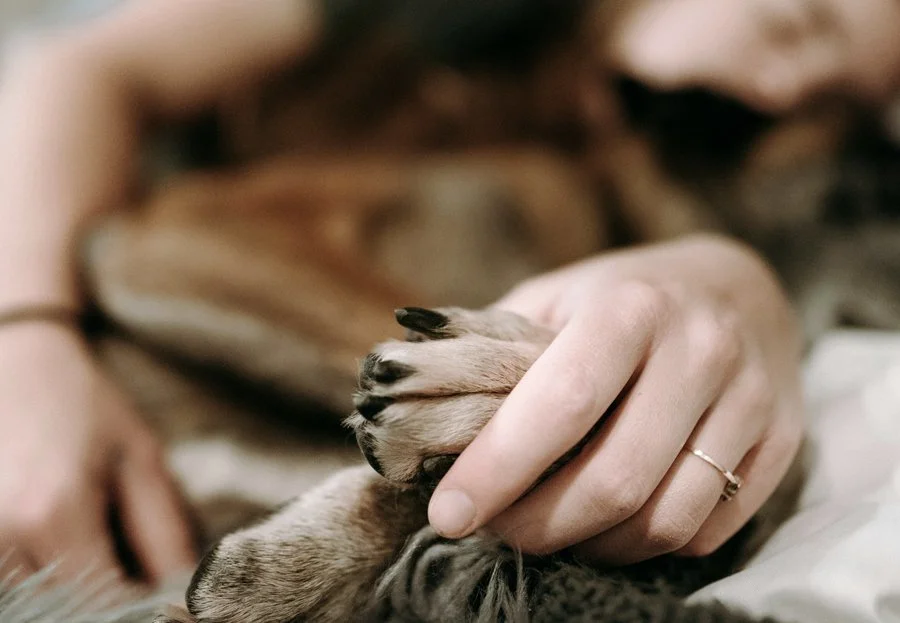
The Human–Animal Bond
Animals are integral to so many of our lives. They offer us a space to be completely and utterly ourselves—without the masks we sometimes feel compelled to wear.
Human relationships can feel fraught and complex. Many of us have been wounded within them. Those experiences can leave us guarded, uncertain, or unsafe. With animals, however, we always know where we stand. We are met with unconditional love—and I mean unconditional in its truest sense.
Our animals love us to the moon and back… no matter what. They not only provide space for us to be our unvarnished selves, but they also invite us to love openly, completely, and without holding back.
When I speak with clients about their inner critic, one of the skills we practice is developing affirmations—learning to speak kindly to ourselves instead of critically. The most accessible way I’ve found to help people locate those words is simple:
Talk to yourself the way you talk to your animal.
“I love you so much.”
“How did you get to be so perfect?”
“You are so beautiful, inside and out.”
“You are so smart… and so good.”
“Nicely done.”
These are words that often flow effortlessly toward our animals.
And yet culturally, we are often given the message that people are more important than animals. This belief can unintentionally invalidate the depth of our love and obscure the primary importance of these relationships—relationships that are vital, supportive, and profoundly life-affirming.
Why This Loss Hurts So Much
There is no way to overstate the essential role animals play in our family systems. They meet our fundamental need for connection in ways our human relationships sometimes cannot.
They offer presence without judgment. Consistency without condition. Love without ambiguity.
In doing so, they give us a felt sense—deep in our bodies—of what it is to be loved in its purest form. That experience becomes wired into our neurobiology: a sense of safety, a sense of being inherently worthy, a sense of connection simply because we exist.
These experiences are not abstract. They shape our nervous system. They lay down neural pathways that support our capacity for regulation, resilience, joy, and connection.
So when we lose an animal companion, we are not just losing a presence—we are losing a relationship that helped organize our internal world.
Reclaiming the Validity of Your Grief
If your grief feels overwhelming, it is not because something is wrong with you.
It is because something deeply right existed.
Disenfranchised grief asks us to do something incredibly hard: to honor and validate our own loss even when the world does not.
But your grief is not too much.
Your love was not misplaced.
This loss is real.
And you were never meant to carry it alone.
Lisa Havelin, LMFT, specializes in the human-animal bond, grief and bereavement, trauma, somatic mindfulness, and chronic pain.